
Earth's Greatest Enemy
My thoughts on Abby Martin's recently released documentary on the US global military empire

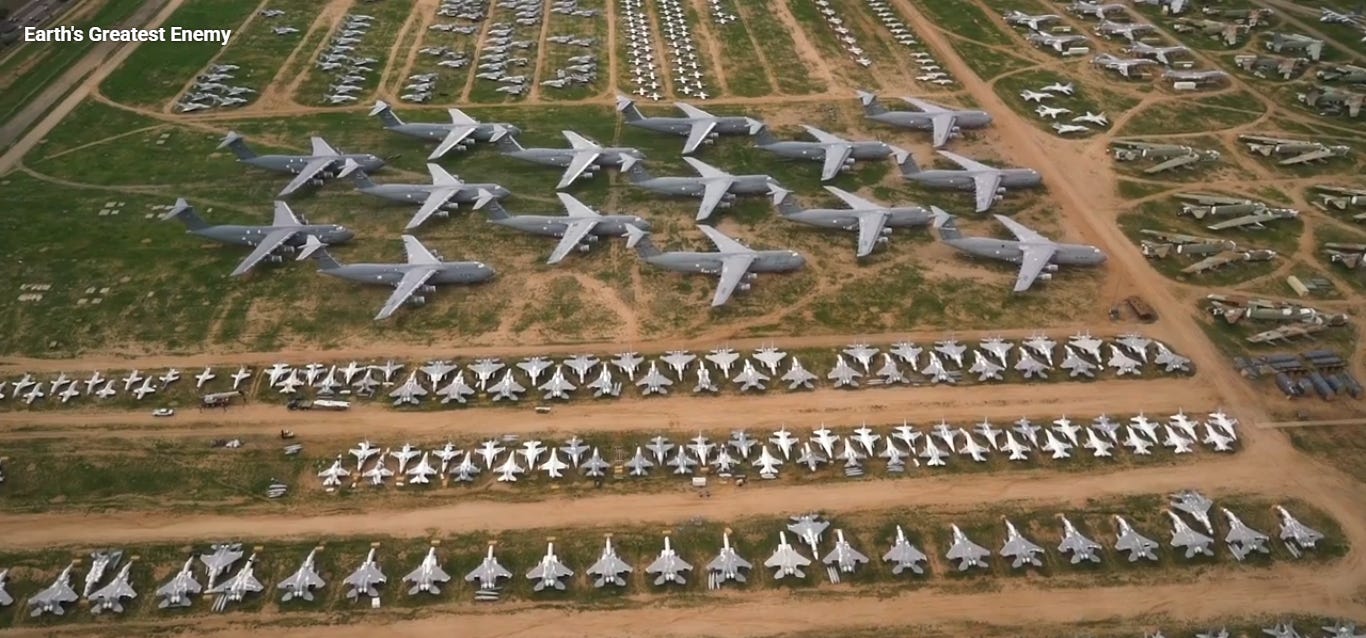
It’s not communism. It’s not terrorism. It’s not a future pandemic. It’s not GMOs. It’s not AI, at least not yet. Earth’s greatest enemy is the US global military empire. One that has served “from the very beginning as a protection unit for resource extraction”. One that stands for dominance, destruction and death.
American journalist and activist Abby Martin’s newly released, hard-hitting documentary, Earth’s Greatest Enemy, is a must-watch not only for those of us who are already deeply concerned about the climate crisis, but more urgently for those who are living either in complete denial or willful ignorance. This film does not offer 2 hours of family entertainment by any stretch of the imagination. But then how much fun does anyone think it will be to swelter in longer heat waves of 40-45◦C; to lose homes, communities and lives to raging wildfires; to flee cities and islands sinking under rising sea levels; to watch children die of cancer caused by exposure to contaminants; to slowly starve to death due to prolonged drought and water shortages? As Martin asks at the beginning of the film, “If we think things are tense now, what should we expect when things actually start to get bad?”
At the beginning of the film, Martin presents some ominous figures:
The USA is responsible for 25% of cumulative carbon emissions compared to China’s emissions at 12%.[1].
The US military is the single greatest consumer of fossil fuels on the planet, burning 270,000 barrels of oil per day and emitting 55 million metric tons of CO2 annually, more than 150 countries.
The US operates 1,000 military bases around the world (Russian has 9 and China 1), most of which are strategically located to ensure easy access to natural resources.
The US air force is bigger than those of the next 5 countries combined.
A Boeing Pegasus burns in one flight more fuel than the average driver would burn in over 40 years. The US flies 600 of these tankers, triple the rest of the world combined.
Scientists estimate the Pentagon’s CO2 output at as high as 165,000 metric tonnes per year.
An armoured division uses 60,000 gallons of gasoline a day.
According to US Department of Defense reports, 28,000,000 pounds of contaminants are dumped annually at military bases in the US and overseas.
Martin’s own investigations along with her interviews with scientists, researchers, legal and environmental experts, and authors establish critical links between:
The flow of oil and gas from the Middle East and US national security;
A capitalist imperialist system that prioritizes profits over people, nature and resources and maintains military superiority to hold this economic system in place through force and power;
Climate change inaction on the part of governments and powerful fossil fuel and arms industry lobbying that suppresses the development of renewable energy, and opens up opportunistic exploitation of the Arctic, the earth largest unexplored area for fossil fuel extraction and its most fragile ecosystem;
NATO expansion and guaranteed weapons sales for the American arms industry.
The film’s sober commentary and stark images expose the far-reaching and horrendous impacts on direct and indirect carbon emissions, widespread environmental contamination and ecocide, human health and suffering, and police militarization. Of all the locations that appear as victims of the US military empire in this film—Iraq, Okinawa, Nigeria, Camp LeJeune, Hawaii, Alaska, Florida—we have only to look at Gaza, Martin points out, to see the worst case of military-wrought genocide and ecocide.
Though it may seem ironic, if not totally absurd as it occurred to me watching this film, that we citizens diligently recycle, separate our trash, bike, walk or take public transportation, and do our best for the environment, a bloated, ever expanding, tax-payer-funded military continues to operate without any accountability, responsibility, oversight or transparency. But does that absurdity render us helpless to do anything about it?
Earth’s Greatest Enemy not only presents the viewer with shocking, frightening and depressing facts and images, but it poses significant questions. In one interview, Dr. Barry Sanders, author of The Green Zone, asks:
What do we do about the military? What do we do about our home and the destruction of the earth as we know it? Nature’s in pain. How do we listen to the cries of those animals that are out there dying? How do we listen to the trees? How do we actually change our point of view, shift totally to hear the last cries, the suffering of this other species? ... I have to sell you a whole new way of looking at this world.
This new and brutally honest way of looking at the world is exactly what Abby Martin and her co-director, Mike Prysner, have achieved with this courageous documentary. And I’m sure they have not made themselves any friends in high places.
“The fight to save the planet,” she says at the end of the film, “is the fight against war and militarism. And we have to get in the way.” I’d say that what needs to be saved is life on this planet, a formidable job that cannot be trusted to any government or organization; rather, it is up to each and all of us to speak out, stand up and fight on any way we can. Because as another interviewee asks in the film: “How do we want to be remembered for how we behaved during this time?”
You can watch Chris Hedges’ interview with Abby Martin here.
I watched the film on YouTube ($5.99 CAD to rent). For more options, Earth's Greatest Enemy.

[1] It is worth noting that the USA at 4.2% of the global population produces more than twice as much CO2 as China with 17% of the global population.
I hope many, many people watch this film, Diane.
As someone who has been involved with the environmental movement for decades, it never ceases to surprise me that lots of people in this movement are unaware of the huge environmental impacts of the military.
And here in Canada, Carney is investing heavily in military and calling it nation building, even as our actual nation burns. It's disgusting.
I agree with you that this film is an important one for all of us to watch. The other problem only briefly mentioned in the doc is the nuclear threat. Right now, I see it as possible that we will extinguish ourselves either through the climate catrastophe or even before if our insane leaders decide to go nuclear in their testosterone driven wars.