
Draw the Line
My thoughts of last Saturday's demonstration in Victoria, BC, and what comes next

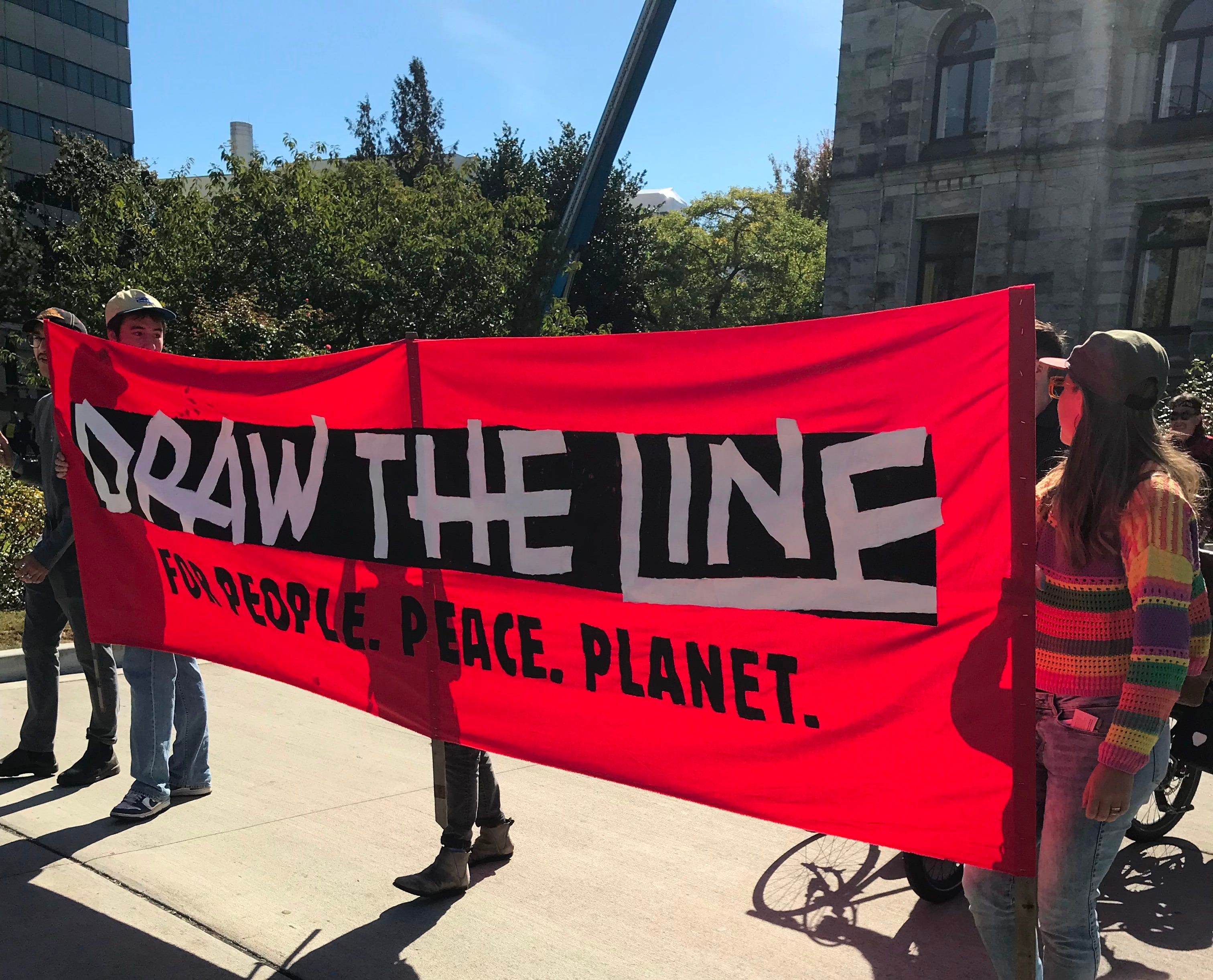
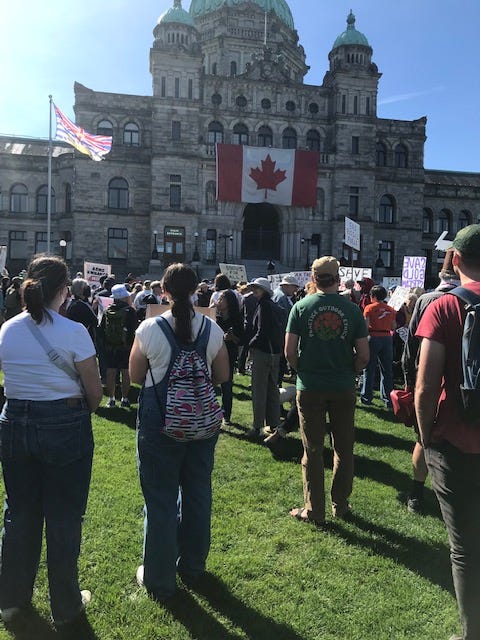
Last Saturday, we took part in the Draw the Line for People, Peace and the Planet protest in Victoria, British Columbia. One of 5 actions that took place on Vancouver Island in a countrywide common front against the Liberal government’s agenda, the rally in front of the provincial legislature was followed by a march through downtown to the Songhees Park. It was encouraging to see all ages from seniors to children gather to express their concerns on a range of issues from indigenous rights, justice and human rights, immigration, climate change, fossil fuels, old growth forests, fracking, to an arms embargo against Israel, genocide and Palestinian solidarity. I cannot offer an exact head count, but the Times Colonist reported hundreds in attendance. (It is noteworthy that although the article specified “an end to global military conflicts” as one of three issues, the reporter did not specifically mention Israel, Palestine or Gaza.) It was the largest demonstration that I’ve ever attended in Victoria.
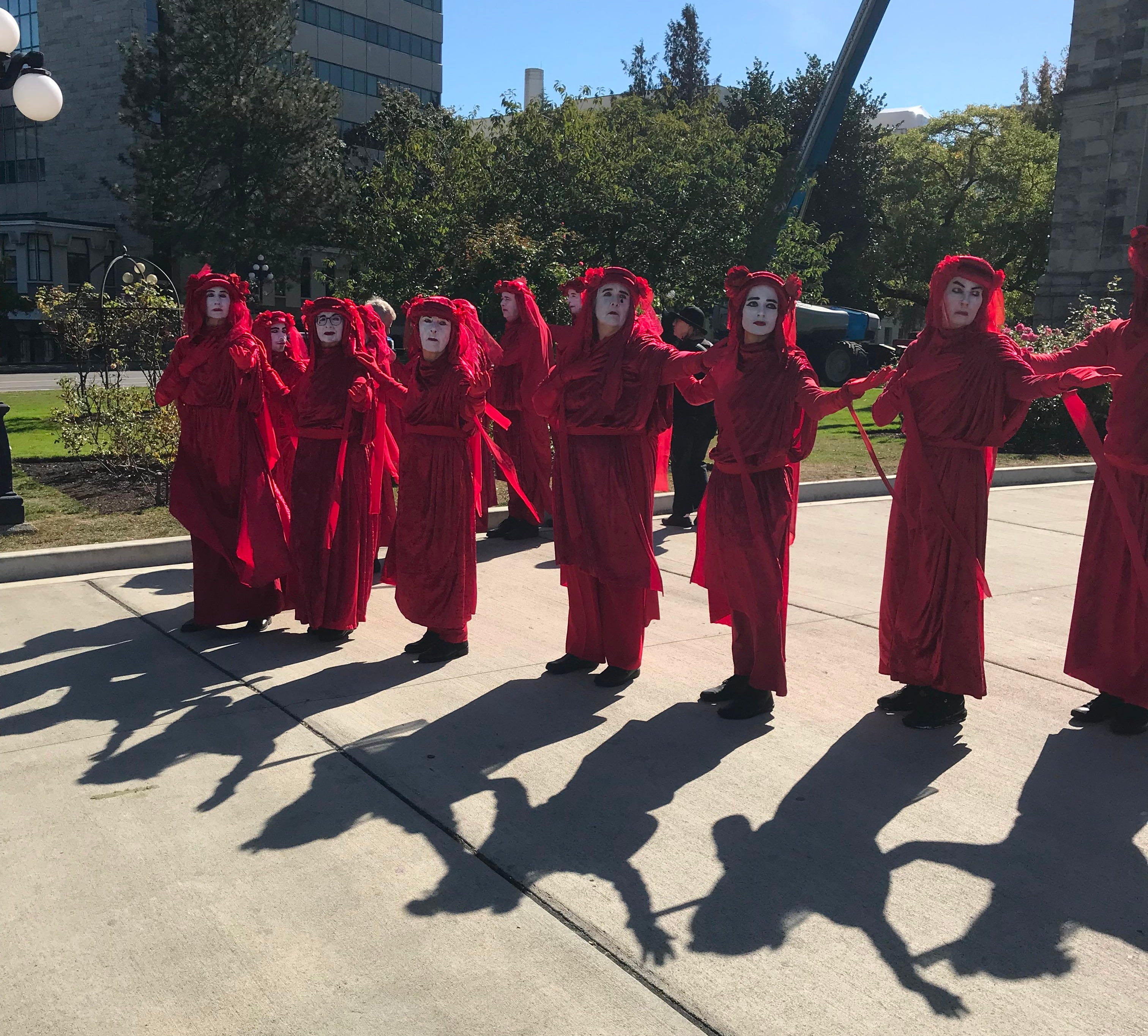
Also very encouraging was the overwhelmingly positive response from shoppers, tourists and local people along Government Street. There were lots of smiles, gestures of solidarity and curious glances as well as picture taking (one can only hope no CSIS agents) and video recording. I heard only one guy shouting obscenities from a car, either because he didn’t share our views or he was pissed off about being stuck in traffic blocked from crossing the bridge.
Two years of a live-streamed genocide in Gaza, three-and-half years of war in Ukraine, and years of ever-increasing environmental degradation have exposed the massive disconnect between growing numbers of ordinary citizens and the so-called elected leaders of so-called Western democracies. And it is more urgent than ever for people to make their disgust, discontent and dismay known to those men and women who have openly supported war over peace, sanctions over diplomacy, censorship over free speech, and fascism over democracy. Never before, at least not in my lifetime, has this disconnect been more glaringly obvious, and more dangerous.
All around the world, protests, general strikes and anti-war, anti-genocide actions are ramping up. We see this in the 70 actions and thousands of Canadians who took part in Draw the Line protests last Saturday. We see this in the latest demonstration in London in support of Palestine Action, a non-violent group that the Labour government has proscribed as a terrorist organization. We see this the 24-hour general strike in Italy on Monday which was attended by thousands of grassroots union members and students. We see this in the launch in late August and early September of the Sumud Flotilla, an international coalition made up of 50 boats carrying humanitarian aid and activists from 46 countries (shamefully no Canadian is among them) in order to break the starvation blockade in Gaza. We have also seen the rage and resistance rising from the bottom being met with increasingly harsh measures from the top in the form of police arrests (1,600 in London) and insidious government authoritarianism.
As Palestinian/American novelist and activist, Susan Abulhawa emphasized in a recent interview with Ahmed Eldin on Out Loud (I urge you to watch this impassioned discussion), the rage people are feeling toward Israel’s western-supported genocide in Gaza has to be turned into action. But, as she points out, this is not easy to do when people, particularly in the West, have been taught through Hollywood films, media reports and discourse, and the education system that Palestinians are “horrible, irrational, violent, scary people” and terrorists. Western populations have also been skillfully taught through psychological manipulation to feel powerless and helpless. Three techniques that keep us passive are, as summarized by Ahmed Elgin in hisSeptember 22 Substack post:
· Learned helplessness: shocks train you to believe nothing you do matters.
· The boiling frog: gradual escalation makes the unacceptable seem normal.
· The bystander effect: the more people watching, the easier it is to assume someone else will act.
I offer the following excuses—and I’m sure there are more—for doing nothing:
I’m too busy with more important things.
I live too far away and don’t belong to any organization.
I don’t feel comfortable being seen in a public event.
I’m not very political or experienced.
I don’t know enough about the issue or have never given it much thought.
I’m afraid of possible repercussions, like losing my job or my friends.
Why should I care when I’m doing just fine?
Solving conflicts is the job of politicians and international organizations.
What every individual does or doesn’t do is ultimately their choice, and we must all live with the consequences of those choices. I understand that of the above-listed excuses, the most valid may be that you don’t feel comfortable participating in public protests. It takes some nerve, but more than nerve, it takes overcoming one’s own inertia and inhibitions. The least valid excuse is fear, because fear is what power thrives and depends on, and fear is what keeps the masses obedient, subservient, complacent and, worst of all, complicit in crimes against humanity.
As Susan Abulhawa mentions, we must all calculate the risks that we are prepared to take. And she offers different steps, some small and some more risky, that we can take (also summarized in the above-linked post):
· Educate and unlearn. Read the histories you weren’t taught. Share carefully sourced material.
· Organize locally. Join or support coalitions, legal funds, boycott campaigns, aid drives.
· Escalate. Decide the cost you carry—time, money, arrest risk—and act.
· Protect storytellers. Journalist, translators, archivists, and families of the disappeared need support.
· Make culture. Art, food, song, and story preserve memory.
· Show up together. A thousand arrests matter less when a hundred thousand arrive the next day.
To me, it all comes down to this: If someone is not willing to stand up for others who are not doing as well as they are in even the smallest way, who do they think will stand up for them when they need support, when the police is knocking on their door, when the government takes away their rights?
Susan Abulhawa presciently concludes her interview with this very Orwellian warning:
They [Israel] are moving in a scientific way to resurrect naked colonialism in a way that is more horrific than anything humanity has experienced. It is driven by technology, it is driven by AI. It’s a window into the future. And if people think it’s going to stop with us [Palestinians], they are tragically mistaken.

Good to see the protestors in Victoria, Diane by people fighting for truth and justice.
I remember back in the last several months of 2002 and first several months of 2003, I participated in massive anti-war marches in San Francisco, Ca. but they didn't stop the Bush/Cheney regime from bombing Iraq and Afghanistan, or occupying those countries, causing so much death, destruction, misery and suffering.
I still think the best way to stop tyrants dictators and war-mongering governments are nationwide general strikes, shutting down commerce, the hospitality industries, and even agricultural work on big corporate farms. Even though the oligarchs and super-rich have more money that they could ever spend or need, they don't like losing a dollar. But this takes an effective effort by working-class people united and sticking together and our needs are met. Definitely not an easy task with so many up to their ears in debt.
I am encourage by any signs that Canadians are are being to awaken and are demonstrating. Though its still so disheartening that read that only hundreds gathered, especially when such events have no admission fee, but Canadians will gather in 10`s of thousands and pay +100$ dollars to watch a hockey game? But hey, its never been possible to understand the mind of Maple Leaf fans.